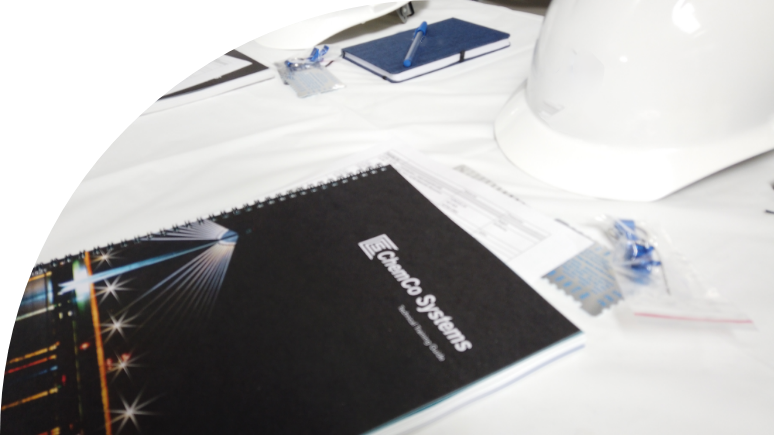
China Vice Construction Minister Dr. Huang
Wei and Bob Gaul discuss future bridge deck projects.
|
| Latest News: |
ChemCo Systems Epoxy Asphalt was
recently installed on several steel deck bridges in China for
2008: Huangpu Bridges in Guangzhou, Xihoumen and Jintang Bridges
in Zhoushan and the 3rd Yellow River Bridge in Jintan. The Xihoumen
Bridge is now the world's third longest span suspension bridge.
2007 projects included: Sutong Bridge, Hangzhou
Bay Bridge, Yanglou Bridge, and Houhai Bridge. Sutong Bridge is
the world's longest span using a cable-stay design. Other new
bridges in Tianjin include the Fu Ming, Chi Feng, Li Gong and
Si Hai Bridges.
Other recently completed projects include: Zhanjiang
Gulf Bridge in Zhanjiang, Pingsheng Bridge in Fushon, Fenghua
Bridge in Tianjin and Nanhuan Bridge in Beijing. The first 2 bridges
are located in Guangdong Province.
These projects followed earlier: 2nd Nanjing,
Taoyaomen, Runyang cable stay, Runyang suspension, 3rd Nanjing
and the Dagu Bridge in Tianjin. |
|
 |
Epoxy Asphalt Concrete is a polymer concrete with a 41 year history
as an extremely durable bridge deck surfacing. Since 1967 over 250 million
pounds (125,000 tons) have been installed on bridge decks totaling over
85 million square feet. Installations have exhibited excellent performance,
including the San Francisco-Oakland Bay Bridge where 30,000 cars travel
each lane per day and the surface has withstood more than 32 years of
extremely heavy use (over 250 million vehicles since installed).
Epoxy Asphalt is specified by Caltrans for the new East Span of the
Bay Bridge (under construction).
Features
Epoxy Asphalt's most common applications are: 1)
as a thin overlay (3/4 to 2 inch thickness) lightweight wear course
for repair or new construction and 2) as a paving surface for orthotropic
steel decks where toughness and elastic composite behavior are critical.
Other benefits include:
| > |
Low porosity prevents deck corrosion |
| > |
Superior substrate adhesion |
| > |
Extreme durability and flexibility |
| > |
Can be installed as thin overlay (3/4") if added weight is critical |
| > |
Roadway open after 1.5-2 hours |
| > |
3-4 times stronger than conventional asphalt concrete |
| > |
Won't rut or shove |
| > |
Applied with conventional asphalt paving equipment |
| > |
Lightweight aggregate O.K. |
| > |
Negligible cure shrinkage |
What is Epoxy Asphalt?
Epoxy Asphalt Concrete is a polymer concrete that
is composed of a slow curing, Epoxy Asphalt binder mixed together with
standard asphalt concrete aggregates in the pug mill of an asphalt plant.
The Epoxy Asphalt binder is a two-phase chemical system in which the
continuous phase is an acid cured epoxy and the discontinuous phase
is a mixture of specialized asphalts. A hot spray application of an
Epoxy Asphalt bond (tack) coat precedes the laying of the Epoxy Asphalt
Concrete. Epoxy Asphalt concrete is applied and compacted with conventional
asphalt concrete paving equipment. The pavement is quickly ready for
traffic in its partially cured state once it has cooled to ambient temperature.
It develops full strength over two to four weeks depending on ambient
temperatures.
Shell Oil Company developed Epoxy Asphalt in the
late 1950's as a jet fuel and jet blast resistant specialty pavement
for airfield applications. In 1967, Adhesive Engineering Company supplied
Epoxy Asphalt for the first commercial application on a bridge deck
as the wear surface of the mile long orthotropic steel deck span of
the San Mateo-Hayward Bridge across San Francisco Bay. This deck is
still in excellent condition after 41 years. Today, ChemCo Systems provides
experienced manfacturing, R&D and technical service consisting of
ex-Adhesive Engineering personnel and continues to improve the performance
of Epoxy Asphalt.
Physical Properties
The two-phase Epoxy Asphalt binder is a thermoset
polymer, that is, it will not melt after it has cured. This is a significant
advantage of epoxy asphalt because conventional asphalts are thermoplastic
polymers that readily melt at elevated temperatures. Fresh laid Epoxy
Asphalt pavement is not subject to rutting or shoving because the polymeric
curing process is advanced during batching to a state of high stability.
Thus, the mix can be designed with a low void content without the danger
of bleeding or flushing. The result is an extremely waterproof pavement
that can be opened quickly.
Substrates
Epoxy Asphalt has excellent adhesion with the following substrates:
| > |
Portland Cement Concrete |
| > |
Lightweight concrete |
| > |
Steel (zinc-primed and unprimed) |
| > |
Asphaltic Concrete and chip seals |
| > |
Tar-Rubber Concrete |
| > |
Epoxy Asphalt |
| > |
Epoxy and coal-tar overlays |
Top of page
|
 |